
DC Decoded
Why Oil Profits When Everything Else Gets Nervous
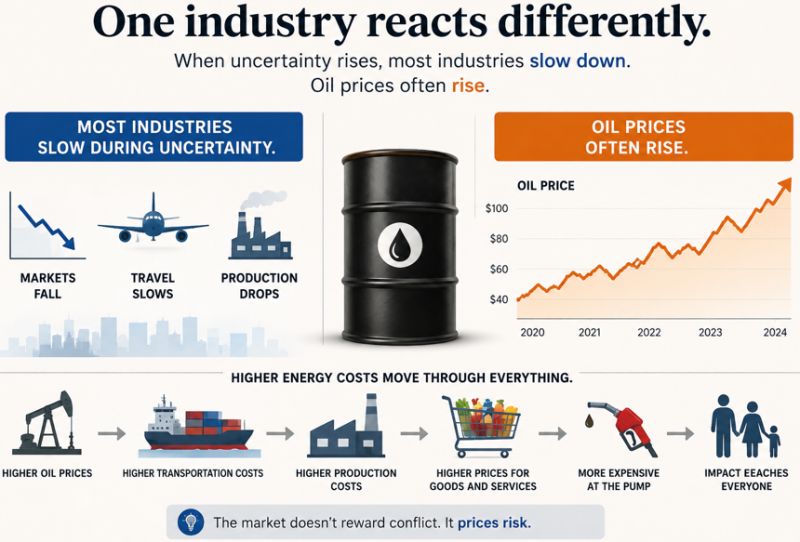
When conflict escalates, most industries turn cautious. Oil prices do the opposite, because production costs barely move even as fear pushes prices up.
Wall Street loves certainty. Predictable earnings. Stable markets. No surprises. The moment uncertainty shows up, most industries struggle. Investments slow down. Hiring freezes. Markets react immediately.
But there is one industry where uncertainty can actually increase profits.
Oil.
When the Middle East conflict escalated, most industries started preparing for disruption. Airlines became cautious. Manufacturers slowed decisions. Markets turned nervous. Oil prices moved the other way.
And the reason is surprisingly simple.
The moment there is even a fear that supply could be disrupted, buyers start bidding prices higher, not because supply has already stopped, but because they are worried it might. That price increase affects almost the entire global market.
Here's the important part. For many oil companies, the cost of producing oil does not change much in the short term. The wells, infrastructure, and workforce are already there. So if oil moves from $70 to $100 a barrel, the production cost may still remain roughly the same. Same barrel, same well, same workers. But now the margin is much higher.
That is what makes oil different from most industries. In many businesses, uncertainty destroys value. In oil, geopolitical uncertainty can sometimes increase it.
At scale, even relatively small price increases become enormous. One Guardian analysis using Rystad Energy data estimated that sustained high oil prices could generate tens of billions in additional profits for major oil companies, roughly $30 million every hour.
But those costs do not stop with oil companies. Higher fuel costs affect transportation. Transportation affects manufacturing. Eventually the cost shows up in everyday goods and services, at the fuel pump, at the grocery store, across the broader economy.