
DC Decoded
From Location-First to Power-First
What changes when data-centre developers stop bringing power to computing and begin bringing computing to stranded energy.
Companion to LinkedIn Post #6 · All figures based on publicly available data as of March 2026
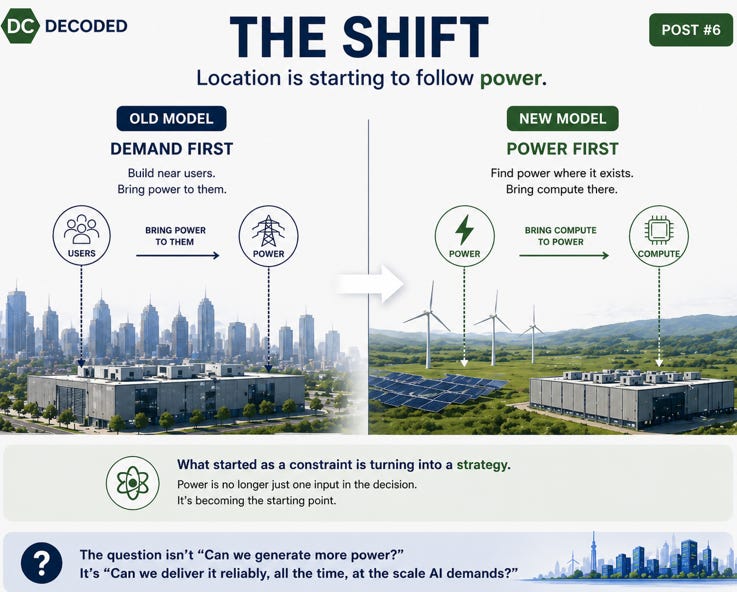
I was recently in a conversation with someone building data center infrastructure at a scale most people in this industry haven’t been close to yet. They described how they think about site selection and it was almost the complete opposite of how I’d been thinking about it.
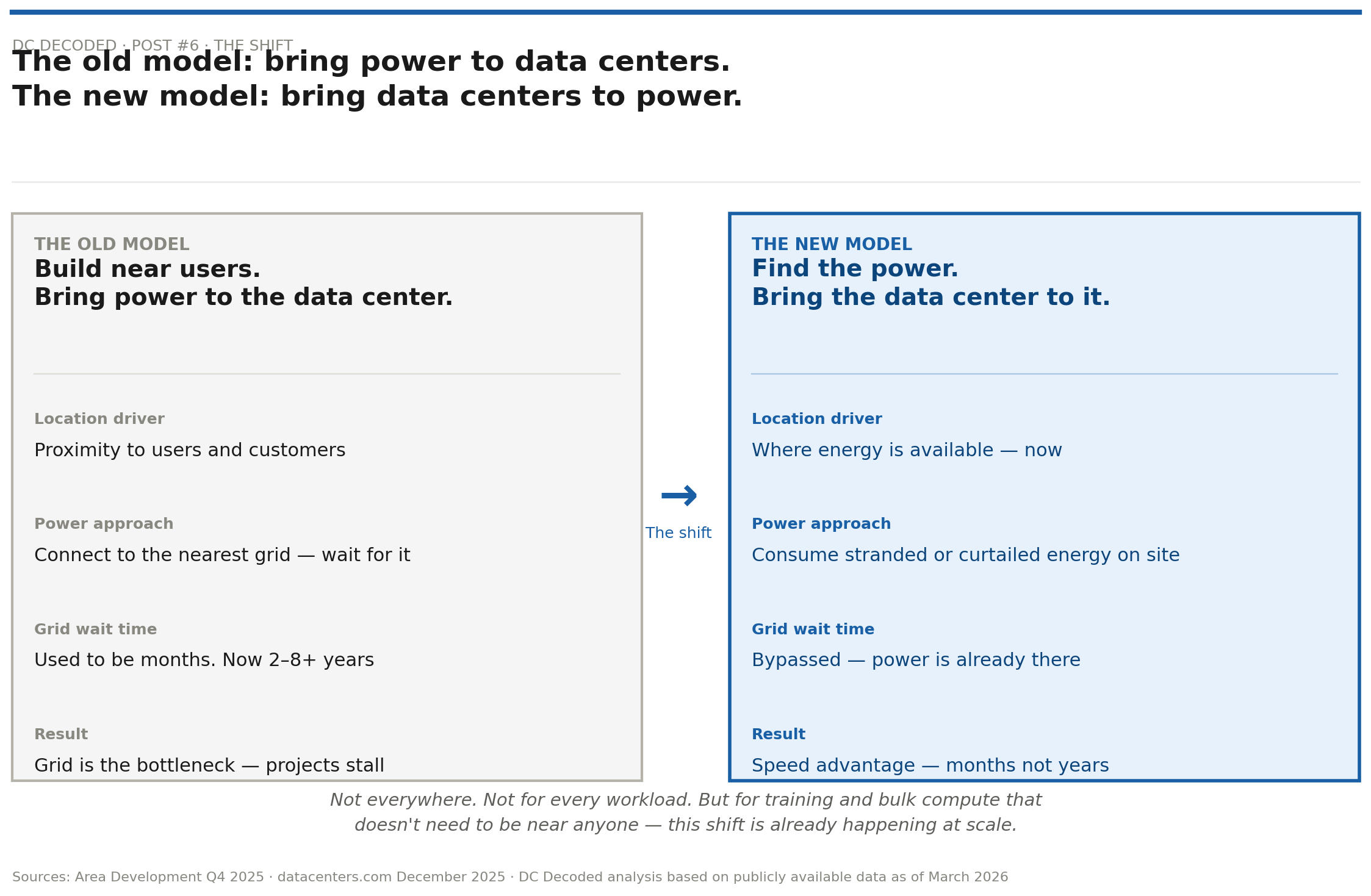
The conventional logic, the one I’d been working with through five weeks of this series, is: build near users, connect to the grid, manage the power constraint. Location drives everything. Power follows.
What they described was a different starting point entirely. Don’t look for users. Look for energy that already exists but has nowhere to go. Find the places where power is being produced and wasted and bring the computing there instead.
It sounds simple. It’s actually a significant reframe. And when I connected it to everything I’d been writing about why grids are so constrained, why APAC markets are redistributing so fast it started to make a lot of things clearer.
Why the old model is breaking down
For most of the industry’s history, you built data centers near large population centres. That’s where the users were, where the connectivity was, where the infrastructure ecosystem made commercial sense. Northern Virginia, Singapore, London none of those places were chosen because they had abundant cheap energy. They were chosen because they had demand.
Power was an input you solved for after you’d picked the location. You called the utility, got a connection, and built. That worked for a long time. Three things are now making it harder.
The first is grid connection times. As I wrote in Post #4, wait times in core APAC markets now exceed 8 years. In parts of the US, utilities have stopped accepting new large load requests entirely. The traditional sequence pick location, get power is breaking down when step two takes a decade.
The second is the nature of AI training workloads. A model being trained doesn’t serve anyone in real time. It just needs power a lot of it, continuously, for weeks or months. It genuinely doesn’t need to be near users. That’s a different profile from anything that drove data center site selection before AI arrived.
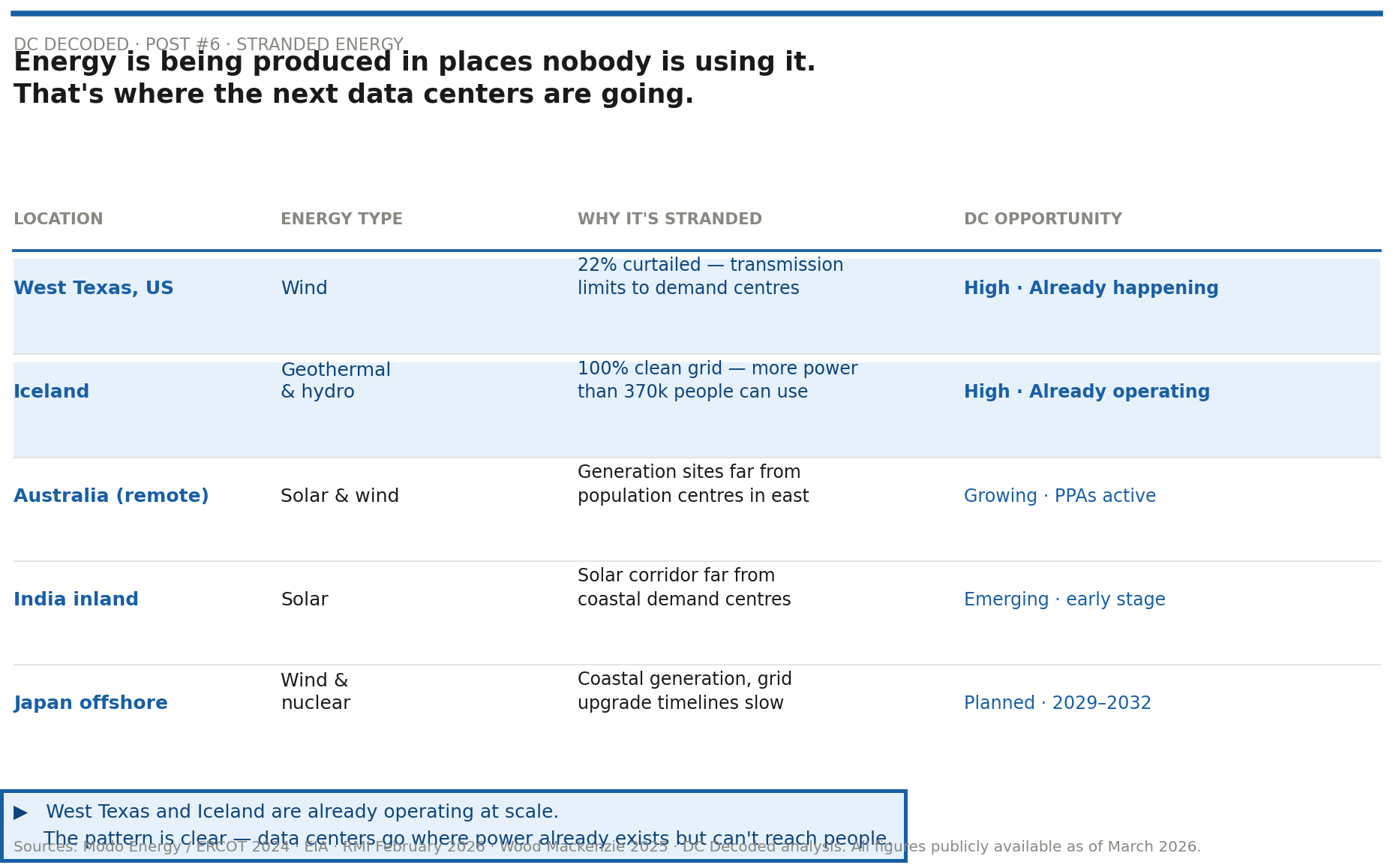
The third is stranded energy. Renewable energy is often generated in places where building transmission to carry it to cities doesn’t make commercial sense. So it gets curtailed produced and wasted. In West Texas, around 22% of all renewable energy produced was curtailed in 2024, unable to reach demand centres further east because the transmission infrastructure simply doesn’t exist (Modo Energy / ERCOT 2024 data). In Iceland, a 100% clean grid produces more power than 370,000 people can consume.
The inversion
The standard response to stranded energy is to build transmission. That’s slow, expensive, and faces the same queue problems as grid connections.
The emerging response is different. Bring the computing to where the energy is. Build the data center at the energy source. Consume what would otherwise be wasted.
And here’s the part that actually changed how I was thinking about this: the data center doesn’t just consume that stranded energy. In many cases it’s the anchor customer that makes the renewable project commercially viable in the first place. Without a large committed buyer for that West Texas wind, the wind farm may never have been built. The data center and the renewable project end up creating each other.
“Data centers stopped being a real estate story and became something else entirely a test of power allocation, infrastructure governance, and political will.” Area Development, Q4 2025
Some of the largest AI campuses being built today are in West Texas, in remote parts of Australia, in Iceland. Not because users are there. Because power is. That’s the inversion in practice.
What this doesn’t mean
The energy-first model doesn’t apply to everything. Most data center capacity the kind that serves real users in real time still has to be near people. When you ask an AI a question, the answer has to come from somewhere close enough that the response feels instant. You can’t serve a user in Singapore from a facility in West Texas without meaningful performance problems.
So what we’re actually seeing is two models running simultaneously. Training workloads and bulk compute the tasks that don’t need to be near anyone can follow power. Inference, real-time applications, anything latency-sensitive those still follow people. The industry isn’t replacing one model with another. It’s building both at the same time, and they’re heading in completely opposite geographic directions.
The question this raises
If you accept that a growing share of compute, specifically the part that doesn’t need to be near anyone, will increasingly follow power rather than users, the natural next question is: what kind of power actually works for this?
Renewable energy in remote locations is abundant. But it’s variable. The wind doesn’t always blow. The sun doesn’t always shine. And a training campus running a model for weeks or months cannot stop because the wind dropped overnight.
There’s a gap between “we have renewable energy here” and “we have the kind of continuous, always-on power a data center actually needs.” The industry has been looking at that gap for a while. And the answer it keeps coming back to quietly, then loudly, is something that most people in this industry weren’t seriously talking about five years ago.
More on this on my next post..
All figures based on publicly available data as of March 2026. West Texas curtailment: Modo Energy analysis of ERCOT 2024 data, October 2025. Grid wait times: JLL Asia Pacific Data Centre Report year-end 2025. Power-first site selection: Area Development Q4 2025; datacenters.com December 2025. This content is original analysis, all source data is cited and publicly available. Views expressed are the author’s own read of available information and should not be taken as investment advice.
Next week on DC Decoded: why the energy-first shift doesn't apply to all data centers equally. That distinction turns out to matters. Follow on LinkedIn and subscribe here on Substack.