
DC Decoded
The Energy I Didn't Know I Was Spending
AI's energy footprint isn't just data centres and water. It's also how verbosely AI responds, and whether three simple prompt changes can cut energy use.
I've spent years working in infrastructure. I know how energy gets wasted at scale. But I wasn't expecting to find it in my own laptop.
A few months ago I went down a rabbit hole reading about AI's energy footprint: data centres, water consumption, grid pressure. The IEA projects AI electricity demand could double by 2026, rivalling the entire power consumption of Japan.
Then I asked a different question. What about the demand I create, every time I open ChatGPT, Claude, Perplexity, or Gemini?
The more I dug, the more one thing stood out: it's not just how often we use AI that drives energy consumption. It's how verbosely AI responds. Every unnecessary preamble, every caveat nobody asked for, every summary of what the AI just said, that's compute running on wasted output. Energy spent on padding, not answers.
Nobody talks about this. And nobody has measured it at the individual user level. So I decided to.
As part of my UCLA Anderson Leaders in Sustainability certificate from UCLA Environment, a graduate programme focused on measurable environmental impact, I built a study to do exactly that.
The study tests whether three simple prompt changes can meaningfully reduce individual AI energy consumption. Measure before, introduce low-energy prompting habits, and measure again.
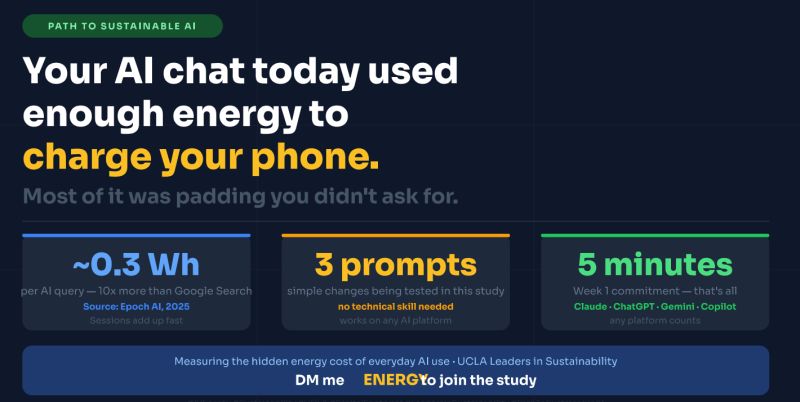
The early results, run across a small group using ChatGPT, Claude, and Gemini, were revealing: responses became dramatically shorter while still answering the question, without anyone changing models, learning prompt engineering, or changing their habits. One small default changed the outcome. As a side effect, the systems used substantially fewer tokens too.
I'm now expanding the study to 100 participants, curious whether ideas from behavioral science and choice architecture can help people use AI more efficiently, without asking them to do extra work.