
Essay
The Generate Button Tells Us Nothing
AI makes creation effortless, but hides the resources behind it. What if AI gave us feedback on energy use the way cars, electricity bills and Screen Time already do?
My wife and I used to have a recurring argument at home.
I would leave the light on in an empty room. Sometimes the fan would keep running after I had walked out. I was also more careless with water than I should have been.
She would notice these things immediately.
I often didn't.
Over time, I became much more conscious of them.
You see a tap running and you know water is being used.
You see a light or fan on in an empty room and you know electricity is being used when nobody needs it.
Recently, I was playing around with AI image generation.
Upload a picture. Ask for a change. Generate.
Not quite right.
Change something. Generate again.
Try another version.
Generate again.
I didn't think much about it.
Then I came across a number that made me look at what I was doing differently.
A 2024 study measuring the energy used by different AI tasks found that image generation averaged about 2.9 watt-hours per image across the models it tested.
To put that into something I could understand, that's roughly the electricity a 10-watt LED bulb uses in about 17 minutes.
The exact number varies considerably depending on the model, hardware and resolution. So 2.9 Wh should not be read as the footprint of every AI image.
But the comparison made me stop.
If I walk past an empty room and see a light on, I notice it.
Yet I can generate five versions of an image, discard four of them, and never once think about electricity.
What finally appears on my screen may be one image. But from my own experience, getting there can take several generations.
And every generation requires computation.
Electricity isn't the only consideration either. All that computing produces heat. Data centres need cooling, and depending on where and how they operate, that can also have a water footprint.
I don't think generating an image for fun is wrong. Nor am I arguing that AI is necessarily worse than other ways of creating something. A designer working on a computer uses electricity too.
AI is not the largest consumer of electricity in the world. Far from it. But the demand behind AI and data centres is growing quickly, and the infrastructure underneath it is remarkably physical — power plants and grids, servers and cooling systems, land and water.
Much of that will become more efficient, and more of the electricity can come from cleaner sources. But demand is growing at the same time. What interests me is that almost none of this is visible at the point where that demand begins: with us.
Something else interests me more.
I can't see any of it.
When I press Generate, the physical resources behind that action disappear from my view.
And perhaps asking people simply to “be more aware” is not much of an answer.
We have solved this differently elsewhere.
My car tells me its fuel efficiency.
It doesn't ask me to stop driving. It gives me information about how efficiently I am using fuel.
My electricity bill tells me how much electricity my household consumed, how that changed over time and how my usage compares with similar households.

And my phone does something similar.
Every week, Screen Time tells me how much time I spent on my phone and whether that went up or down.
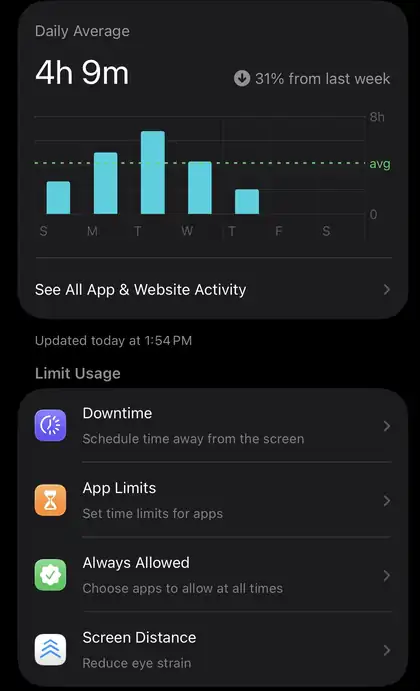
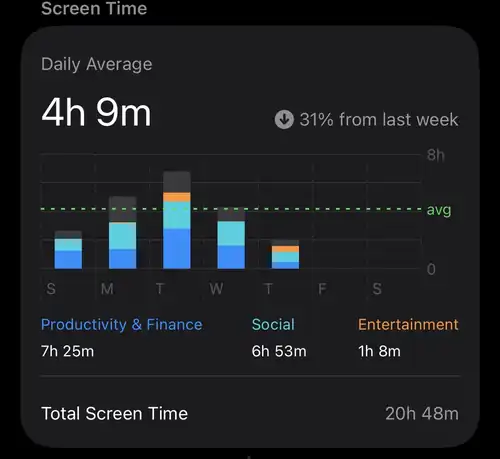
It doesn't stop me from opening another app.
It gives me feedback.
So why couldn't AI do something similar?
Imagine a simple weekly report:
Your AI Resource Report
Estimated energy used this week
Change from last week
Number of images generated
Energy used by image generation
Your average over time
Or perhaps something even simpler — an AI equivalent of the mileage indicator in a car.
Not a warning.
Not a guilt score.
Just information.
And this isn't entirely hypothetical.
Google has already published a methodology for estimating the energy, carbon and water footprint of AI inference at scale.
Would an energy number beside every prompt be perfectly accurate?
Probably not.
Models differ. Hardware differs. Data centres differ. Electricity sources and cooling systems differ. Water use varies even more.
But perhaps it doesn't need to pretend to be perfectly precise.
An estimate can still provide useful feedback.
There may be another reason this matters.
AI is becoming faster, cheaper and easier to use.
That is a good thing.
But if something becomes twice as efficient and we start using three times as much of it because it has become effortless, efficiency alone doesn't necessarily reduce total consumption.
That brings me back to the light in my house.
My wife wasn't asking me to sit in the dark.
She was asking me to switch off the light when I didn't need it.
Eventually, I learned to notice.
Perhaps AI doesn't need more lectures telling people to use it responsibly.
Perhaps it needs something much simpler.
A meter.
My car tells me my fuel efficiency.
My electricity bill tells me how much I used.
My phone tells me how my screen time changed.
None of them tells me what I should do.
They give me feedback.
Why shouldn't AI do the same?
The goal is not to make AI harder to use.
It is to make what happens behind the Generate button a little easier to see.
Sources & Further Reading
Luccioni, Jernite & Strubell — Power Hungry Processing: Watts Driving the Cost of AI Deployment? (ACM FAccT, 2024)
Energy measurements across machine-learning inference tasks, including the image-generation benchmark discussed above.
Google — Measuring the Environmental Impact of Delivering AI at Google Scale (2025)
Google's methodology for estimating the energy, carbon and water associated with AI inference.
Lawrence Berkeley National Laboratory — The Water Use of Data Center Workloads (2025)
Research examining how data-centre workload water use varies with cooling technology, climate, electricity source, server efficiency and other factors.
International Energy Agency — Energy and AI
Analysis of global data-centre electricity demand, AI-driven growth, energy supply and the infrastructure implications of expanding compute.