
DC Decoded
Follow the Cash
A lesson from evaluating real businesses: revenue tells a story, but free cash flow reveals whether the business is truly healthy.
The Lesson From My Capstone
For our UCLA Anderson EMBA capstone, my team spent months evaluating businesses in the fire and life safety industry.
Real companies. Real owners. Real financials.
And every single time we sat down to evaluate an acquisition target, the same debate came up.
Revenue looks good. Earnings look clean. But is this business actually healthy?
The answer was never in the income statement. Revenue can be timed. Earnings can be managed. Accounting gives you room to tell a flattering story.
Cash is harder to fake.
Free cash flow, what’s actually left after a business pays for everything it needs to run and grow, became our real scorecard.
Our mentor put it simply. No free cash flow, no real business. Everything else is just accounting.
Think of it like your salary. You earn $120,000 a year. After rent, bills, and everything else, you have $10,000 left. That $10,000 is your free cash flow. That’s what you can actually do something with.
A company is no different.
Why I Started Looking At AI
For months, the same headlines kept appearing.
AI is driving the bull market. Earnings are surging because of AI. The largest technology companies in the world are becoming more valuable because of AI.
And yet something felt off.
So I applied the same lens we used in our capstone.
What does the cash actually say?
The Scale Of The AI Buildout
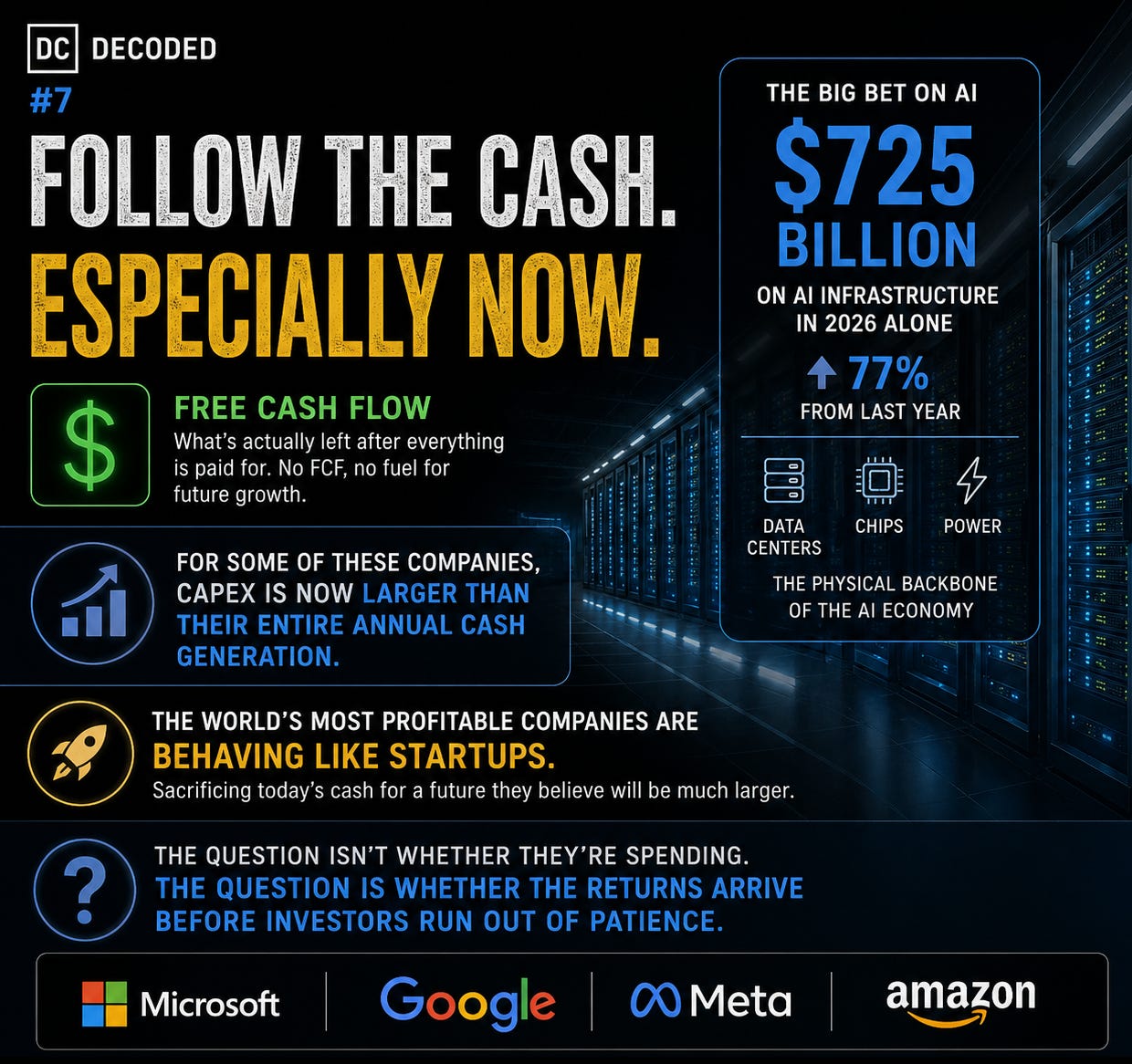
Microsoft, Google, Meta, and Amazon are together spending $725 billion on AI infrastructure in 2026 alone. Up 77% from last year.
But here is what that number actually represents on the ground.
Data centers the size of small cities. Millions of GPUs stacked in server racks. Fiber networks spanning continents. Power substations. Cooling towers consuming millions of gallons of water. Land acquisitions across multiple countries.
Why This Isn’t The Dot-Com Bubble
The easy comparison is 1999. Companies spending recklessly on infrastructure that never paid off.
But there is a meaningful difference worth considering.
The dot-com boom primarily transformed how technology companies operated. The AI buildout is creating demand far beyond technology across utilities, construction, real estate, water infrastructure, engineering, and manufacturing.
The infrastructure being built today is not just enabling AI. It is becoming an economic engine in its own right.
That’s why comparison to 1999 may be too simple.
The Cash Flow Problem
Here is what $725 billion in spending is doing to free cash flow across the four companies.
Amazon - free cash flow fell from $38 billion to $11 billion in a single year. Now planning $200 billion in capex for 2026. Analysts expect free cash flow to turn negative.
Google - generated $73 billion in free cash flow in 2025. Planning to spend $180 to $190 billion this year. More than its entire annual cash generation. Analysts project a near 90% decline.
Meta - free cash flow fell 19% last year. Planning to spend up to $145 billion in 2026. Nearly double what it spent in 2025.
Microsoft - the most measured of the four. Analysts still expect free cash flow to fall 28% this year.
AI revenue is growing. But capex is growing faster.
The question is not whether returns will come. The question is whether they arrive fast enough.
The Startup Comparison
Here is what makes this moment genuinely unusual.
These are not struggling companies making desperate bets. These are the most profitable businesses on earth.
And they are choosing to spend their cash faster than they generate it.
They are behaving like startups.
Sacrificing today’s cash for a future they believe will be much larger. Pursuing market dominance before the window closes. Betting that whoever builds the most infrastructure today controls the economics of AI tomorrow.
Every transformative technology wave required this kind of upfront investment before the returns arrived. Railroads. Electricity grids. The internet.
Maybe this is that moment.
Or maybe the returns take longer than investors expect.
That gap - between the bet and the payoff - is exactly what I want to understand.
What I’ll Be Looking For
Over the next four posts, one company at a time.
Amazon - the most dramatic free cash flow collapse of the four. Yet AWS is the most profitable cloud business on earth. How does the most profitable cloud company end up with nearly no free cash flow?
Microsoft - the most measured spender of the four. But the OpenAI relationship is a wildcard nobody has fully priced. What does that bet actually cost?
Google - the fastest growing cloud of the three. But also the most threatened by AI itself. Over half of Google’s revenue comes from search. AI is already changing how people search. Google may be spending to protect what it has as much as to build what’s next.
Meta - no cloud business. No enterprise customers. Every dollar spent on AI has to pay back through better ads on Facebook and Instagram. The boldest bet of the four.
Same question for all four - where did the cash go, and is the bet going to pay off?
Cash tells the truth.
The AI race may ultimately be won by the company that converts infrastructure spending into cash flow fastest.
That’s the number I’ll want to explore through this series.
#DCDecoded #FreeCashFlow #AI #DataCenters #BigTech #Investing