
DC Decoded
Why Power, Not Space, Is the Only Thing That Matters
The old real-estate mental model for data centres is breaking down as rack density and reliable power become the defining constraints.
I spent years selling into data centers across Singapore, Malaysia, and India. Early in my career I made the same mistake most people outside the industry make: I thought data centers were fundamentally a real estate business. Big buildings, lots of servers, lots of cooling. The more space you had, the more capacity you could sell.
That mental model was wrong then, and it is almost entirely irrelevant now.
Today, every serious conversation in the data center industry starts with one question not how much floor space do you have, but how much power can you deliver, how reliably, and at what density? Understanding why requires understanding one concept: rack density.
Why data centers are measured in power, not space
Most people picture a data center as a big building full of servers. That’s not wrong but it leads to the wrong question. The question the industry actually asks is: how much power can it draw?
The reason is simple. You can always put more servers in a building. You can’t always get more electricity to run them. Power is the real constraint.
Power and energy are not the same thing. Power is how much electricity is flowing right now like the width of a pipe. Energy is what you get when power flows over time. Your electricity bill measures energy. A data center’s capacity is measured in power. So when someone says a data center has 100 MW of capacity, they mean: at full load, that facility can draw 100 megawatts from the grid continuously right now, for as long as it’s running. Not a tank that empties. A pipe that stays open.
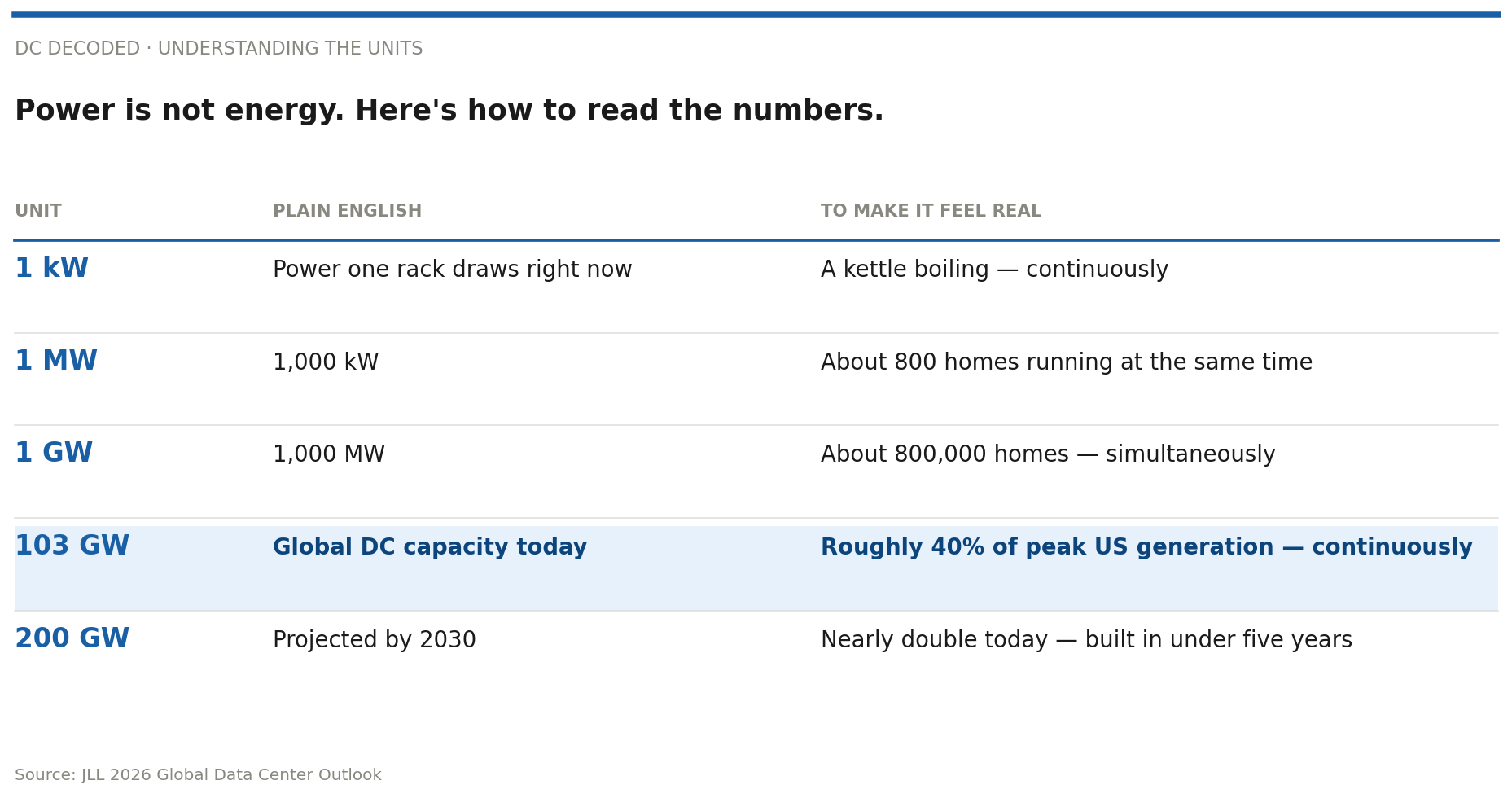
That last number 103 GW today, 200 GW by 2030 is not a forecast someone made up. That’s where the signed leases, construction starts, and capital commitments currently point. Getting there will require around $3 trillion in total investment.
What is a rack and what is rack density?
A rack is a standardised metal cabinet typically around 2 metres tall and 60 centimetres wide that holds servers, networking equipment, and storage hardware. Think of it as the basic unit of a data center, the way a shipping container is the basic unit of global trade. Thousands of racks, arranged in rows across a data center floor, make up what the industry calls capacity.
Rack density is simply how much electrical power a single rack draws, measured in kilowatts (kW). Power goes in. Servers compute. Heat comes out. The more power a rack draws, the more compute it delivers and the more heat that has to be removed.
The formula for total DC capacity is straightforward: total racks × average kW per rack = total power capacity in MW. A data center operator doesn’t sell you floor space. They sell you power.
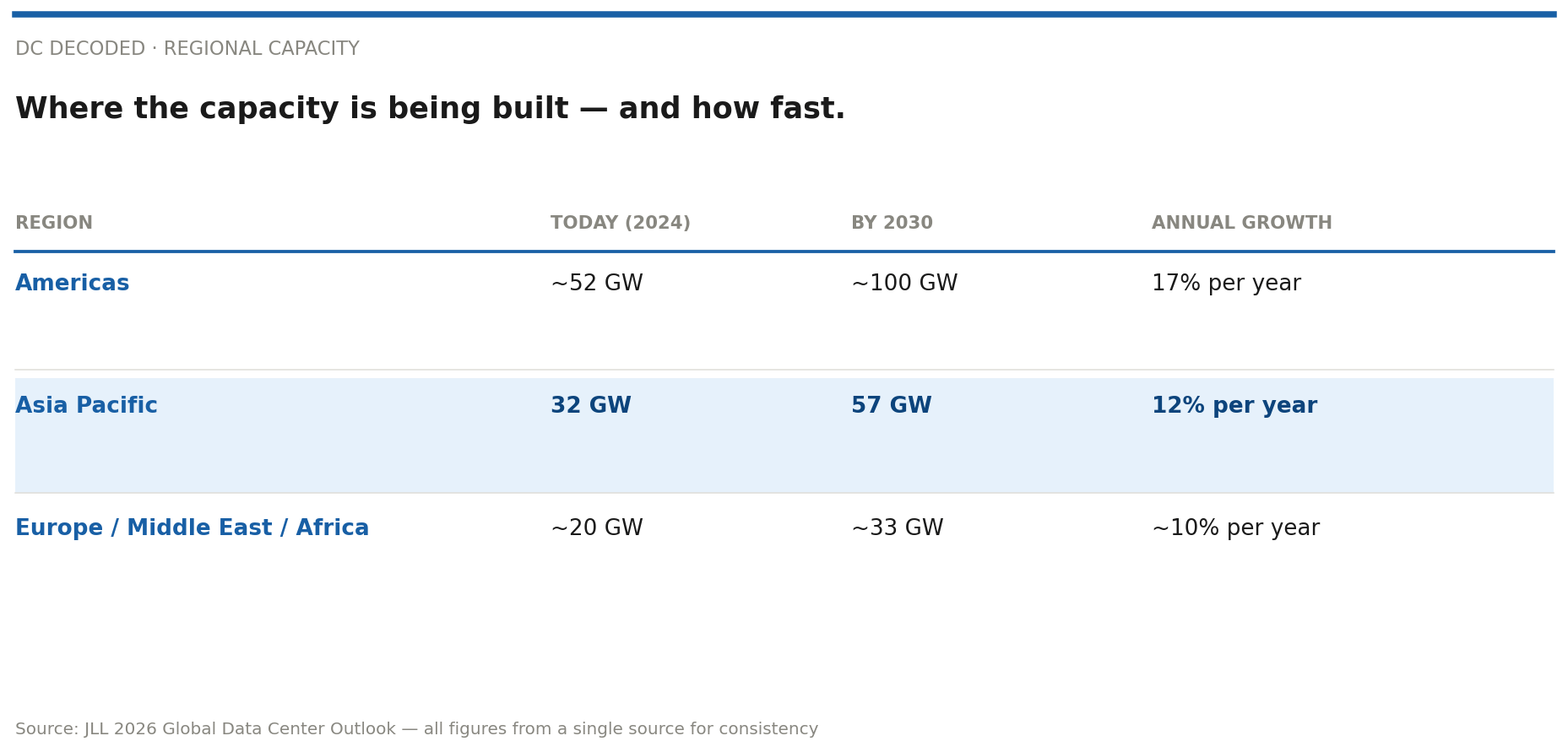
For most of the industry’s history, density crept upward slowly. Then AI arrived and it didn’t creep. It jumped.
Where the capacity is being built
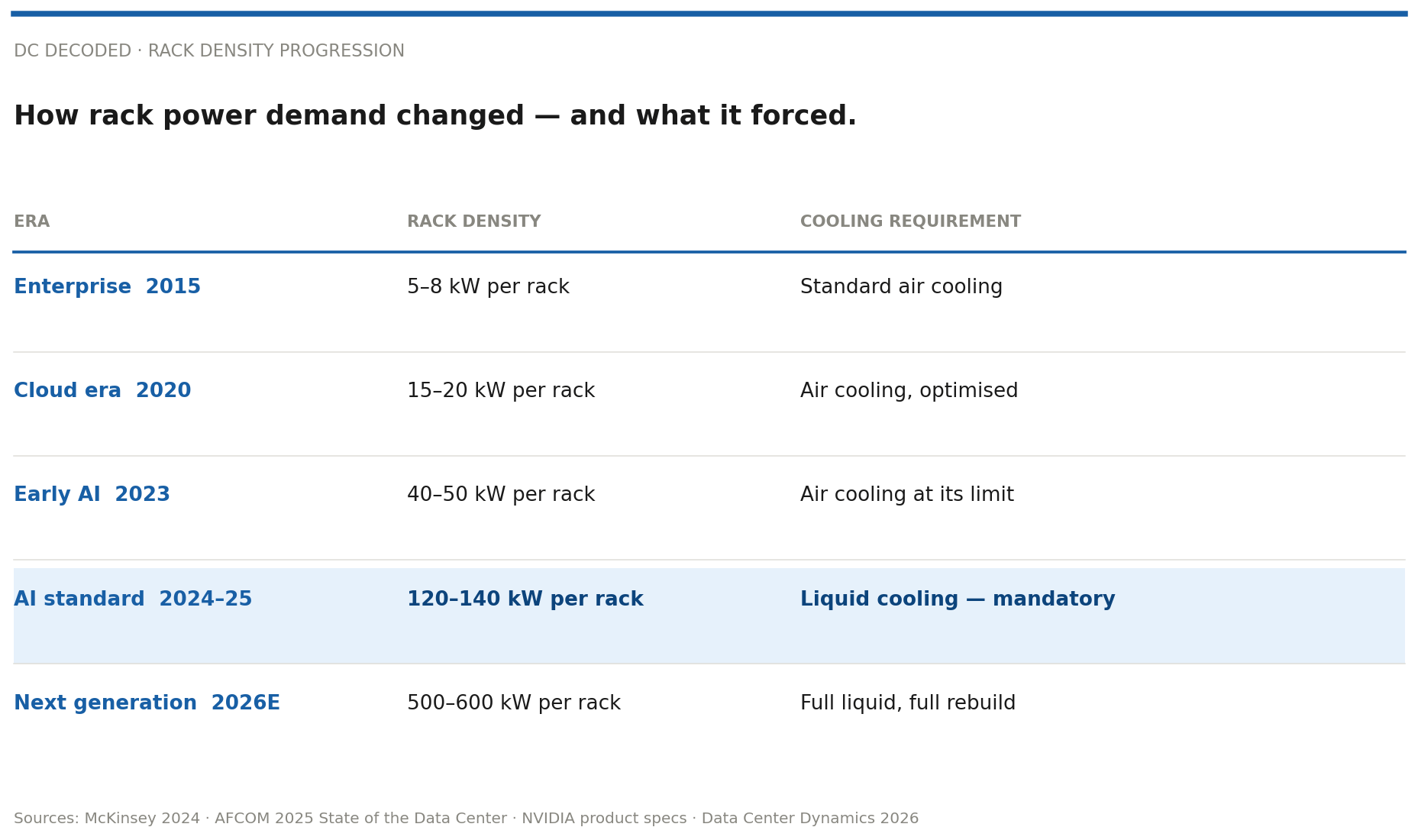
The Americas dominate roughly half of global capacity today, growing at 17% per year through 2030. The US drives most of that. The grid is more accessible than most markets, regulation is workable, and the companies behind most of the demand are American.
Asia Pacific is the more interesting story for me. I spent years working in Singapore, Malaysia, and India watching this industry from the inside. The region is at 32 GW today and is projected to reach 57 GW by 2030. That sounds like a clean growth story. On the ground it’s messier Singapore hit grid limits and paused new permits, Malaysia moved fast to fill the gap, India is building at a pace the grid isn’t fully ready to support. The number is real. The path to get there is complicated.
Why air cooling failed and why liquid became mandatory
Air cooling hits a hard physical wall at around 50 kW per rack. This is not an engineering preference it is thermodynamics. At that density, you cannot move enough air through the narrow gaps between servers to remove the heat they generate.
Water conducts heat approximately 3,500 times more effectively than air. Above 50 kW, liquid cooling is not an option the industry chose it is the only option that works. Direct-to-chip cooling attaches cold plates directly to GPU and CPU surfaces. Immersion cooling submerges entire servers in dielectric fluid. Both handle densities that air cooling cannot touch.
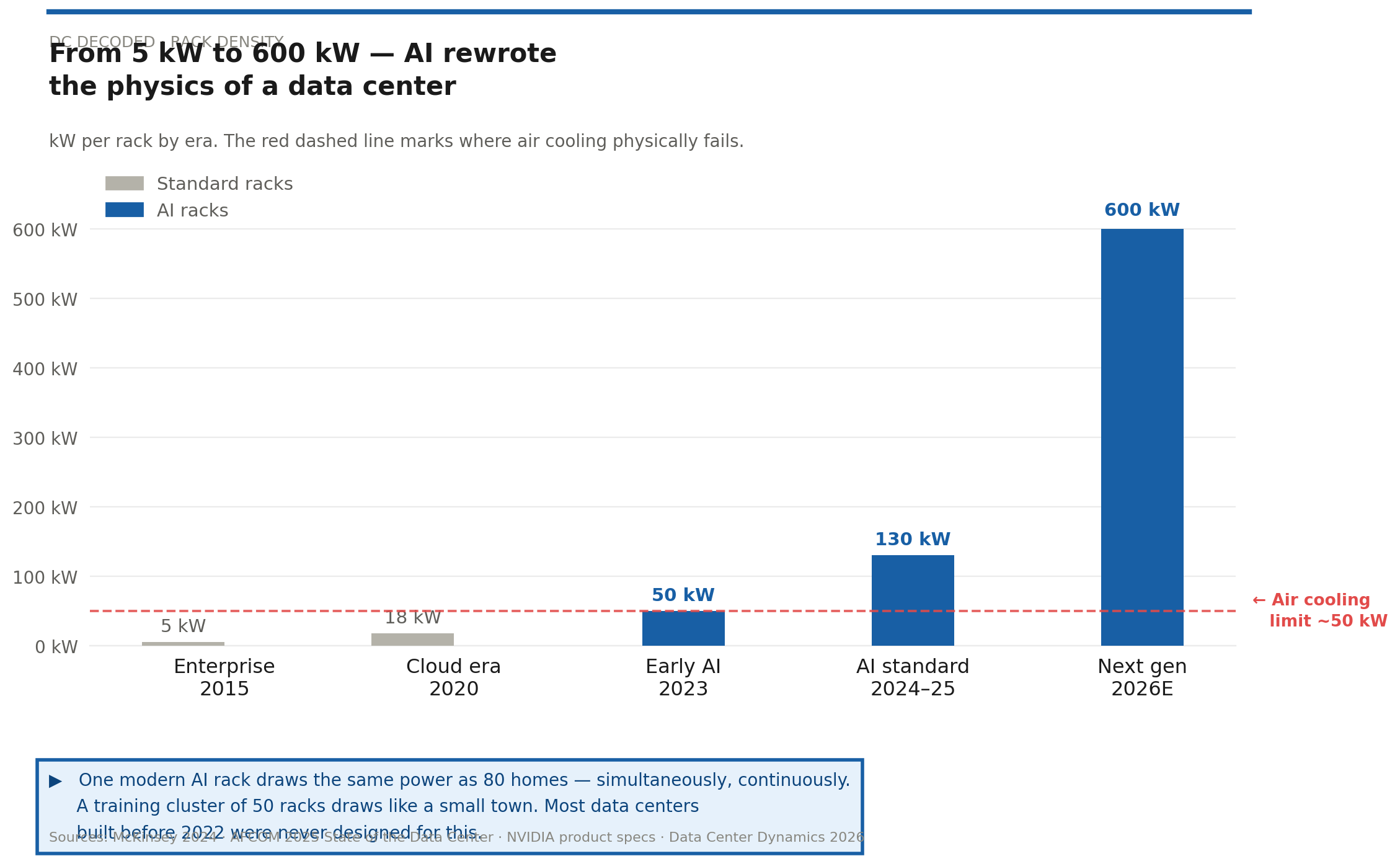
What this means in practice is a near-total rebuild of data center infrastructure. When density doubles, you don’t just add more cooling. You redesign the power distribution system, resize the UPS, upgrade the busway, reinforce the floor loading, and reconfigure the entire facility layout all simultaneously. Most data centers built before 2022 were designed for 10–20 kW racks. They cannot simply retrofit to handle 120 kW. They have to rebuild.
This is why the average cost to build one megawatt of data center capacity rose from $7.7M in 2020 to $10.7M in 2025 a 39% increase in five years. It is not inflation. It is a fundamentally different product being built for a fundamentally different level of demand.
“The question in every commercial conversation used to be: how much space do you need? That question is gone. Now it’s always: how much power can you get, and how fast?”
What this means in practice
When I was working in the data center ecosystem in Singapore and Malaysia, the commercial conversation was about space, connectivity, and uptime. Those things still matter. But they are now secondary to one question that operators, developers, and investors are all trying to answer at the same time: where is the power, and can you get it in time?
Grid connection lead times in primary markets now exceed four years. Equipment lead times have stretched to 33 weeks up 50% from pre-2020. The markets winning the next phase of data center expansion are not the ones with the most capital or the most land. They are the ones that can answer three questions faster than anyone else: where is the power, who controls the land, and how quickly can permits move.
Rack density is where that pressure starts. Everything else the investment, the grid strain, the infrastructure rebuild flows from the fact that a single AI rack now draws what 80 homes use.
This is the deep-dive companion to DC Decoded Post #2 on LinkedIn. Next week: why compute demand keeps rising even as AI models get more efficient — and why the answer is not what most people assume. Follow DC Decoded on LinkedIn and subscribe here on Substack.