
DC Decoded
Why the Grid Can’t Keep Up
The energy may exist, but delivering it reliably is a different challenge—especially as data-centre demand accelerates.
DC Decoded · Companion to LinkedIn Post #4 · All figures based on publicly available data as of March 2026
The first three pieces in this series were about demand why it’s rising, what’s driving it physically, and why it won’t slow down even as models get more efficient. This one is about supply. Specifically, why the infrastructure that delivers power to a data center is becoming one of the hardest problems in the industry and what a blackout in Spain in April 2025 revealed about the shape of that problem.
What actually happened in Spain
On 28 April 2025, at 12:33 in the afternoon, the power systems of Spain and Portugal went down completely. Tens of millions of people lost electricity. It was Europe’s most severe grid failure in over two decades.
The immediate story on social media, in political speeches, in newspaper headlines, was renewables. Spain had been running on a high share of solar power that day. The argument ran that clean energy made the grid fragile. Some called for a return to conventional baseload. The story spread fast and stuck.
It was wrong.
The ENTSO-E Expert Panel - 49 investigators from transmission system operators across Europe, spent eleven months working through the data. Their final report, 440 pages, published March 2026, was specific about the cause.
“The problem is not renewable energy, but voltage control, regardless of the type of generation.” - ENTSO-E Board Chair, March 2026
What happened was this. Voltage oscillations developed in southern Spain. Renewable plants were operating in fixed-power-control mode, a grid configuration that meant they injected reactive power in a way that amplified the oscillations rather than stabilising them. Conventional generators, which should have compensated, failed to deliver the reactive power the system needed, several reached less than 75% of required output at critical moments. Between 12:32 and 12:33, more than 2.5 GW of generation was lost in seconds. The system lost synchronisation with the wider European grid at 12:33:19. Fifteen contributing factors were identified. None was simply “too many solar panels.”
The lesson is not that renewables are dangerous. The lesson is that a grid with high renewable penetration needs active voltage management systems, grid-forming inverters, synchronous condensers, reactive power assets, designed to handle speed and variability. Having the energy is not the same as being able to deliver it stably. That distinction is what most people missed.
Why this matters for data centers specifically
Data centers are among the most demanding grid customers in existence. They need power that is continuous, stable, and predictable, not 99% of the time but all the time. Even a brief voltage fluctuation can crash servers or corrupt data. UPS systems and backup generators handle outages, but they assume the grid delivers stable power at the input. They are insurance against disruption, not a substitute for grid quality.
The Spain blackout reframes the siting question for data centers in a way that is still working its way through the industry. The question used to be: is there enough power in this market? The question is now: is the grid in this market engineered to deliver power stably at the scale and density we need, and does it have the management systems to handle rapid change?
Those are very different questions. And in conversations I’ve had with industry people working across APAC markets, the Spain event came up more than once, not as a scare story, but as something that sharpened thinking. A lot of markets realised, perhaps a little later than they should have, that building generation capacity and building grid management capability are not the same thing. You can have solar. You can have wind. And you can still fail a data center operator if the grid can’t handle fast change reliably.
The APAC grid reality
In APAC, the grid constraint shows up in two ways simultaneously.
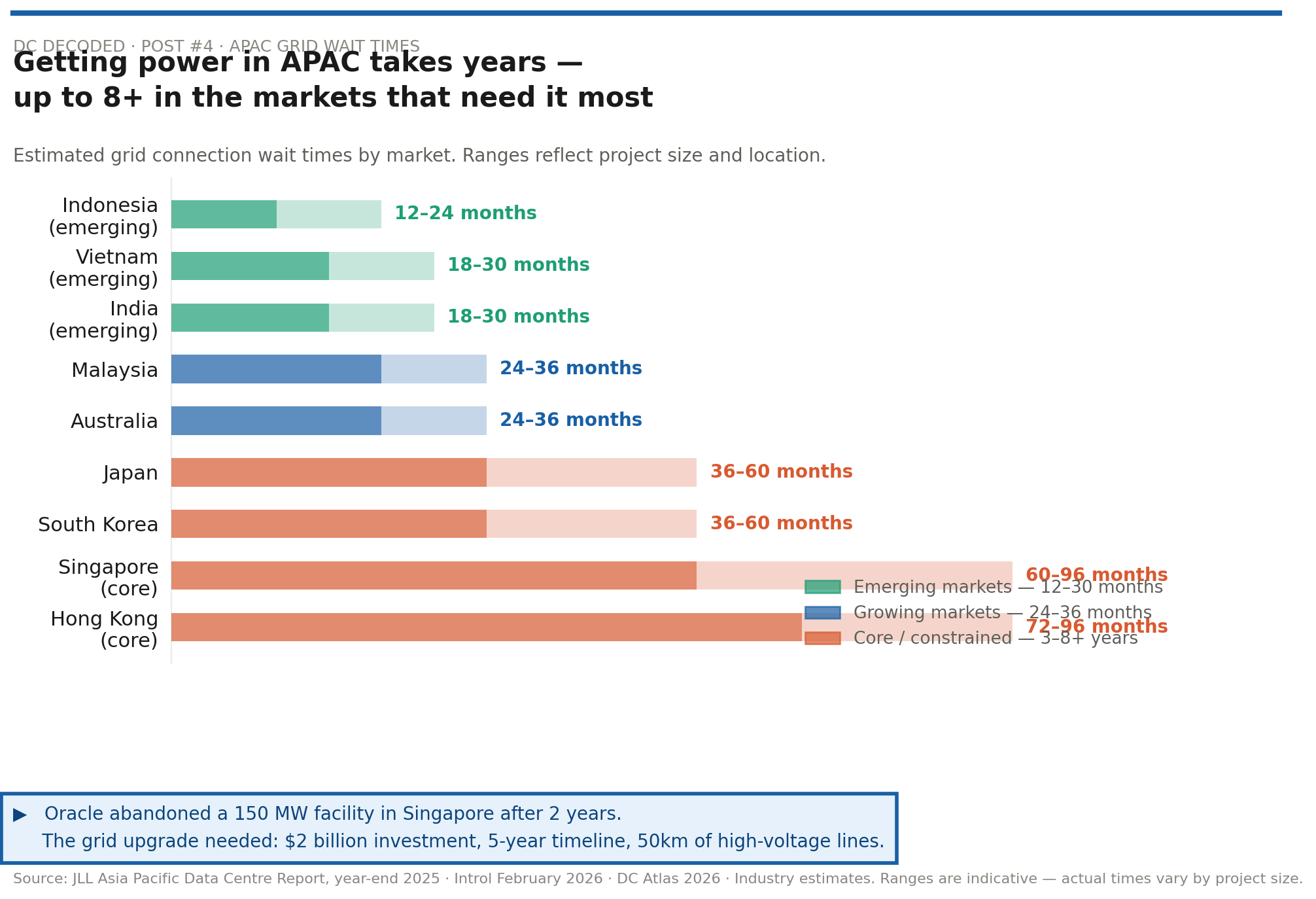
The first is simply connection time. According to JLL’s Asia Pacific data center report for year-end 2025, grid connection wait times across the region now run from 24 months in emerging markets to more than 8 years in core markets. This isn’t a permitting problem or a political problem. It’s a physical infrastructure problem. Transmission lines and substations take years to plan, approve, and build. The queue is long because the grid is being asked to grow faster than it structurally can.
Oracle abandoned a planned 150 MW data center in Singapore after two years of negotiations could not secure a power connection. The assessment was that serving that facility would require a $2 billion investment and a 5-year construction timeline just to upgrade 50 kilometres of high-voltage transmission lines. For one building. That is what the physical constraint looks like up close.
The second problem is stability. Markets like Malaysia, India, and Indonesia are adding renewable generation quickly, partly to meet growing demand, partly because hyperscalers increasingly require clean power as a condition of their lease agreements. But adding renewable capacity to a grid without simultaneously upgrading the management systems, the voltage control, the reactive power assets, the grid-forming inverters, creates exactly the kind of vulnerability Spain exposed. The energy is there. The grid management may not be ready.
Why nuclear is back and what that actually means
The Spain blackout didn’t cause a retreat from renewables. What it did was accelerate a conversation the industry was already having: what provides the stable, continuous, always-on baseload power that data centers genuinely need?
Solar and wind are variable by nature. They produce power when the sun shines and the wind blows. For most electricity consumers that’s fine, the grid smooths it out. But a data center needs power regardless of the weather, continuously, for as long as it operates. Grid storage helps. But at the scale the industry is now building, something more is needed.
That’s the gap nuclear fills. Not because it’s new, nuclear has been around for seventy years, but because the data center industry has arrived at a power requirement that renewables alone cannot reliably meet. In the last two years, the hyperscalers have moved from studying nuclear to signing contracts
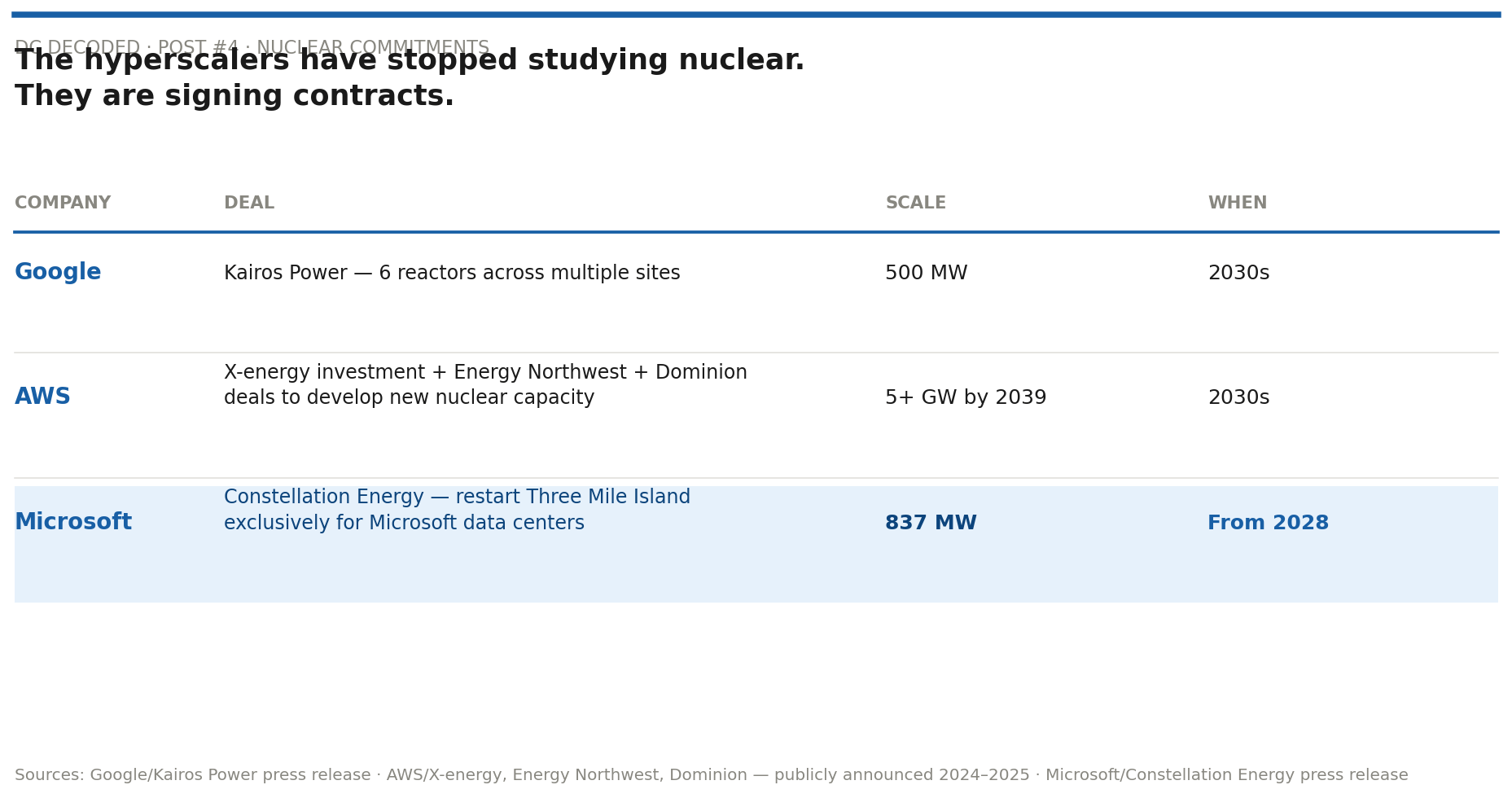
Google signed a deal for 500 MW of power from Kairos Power across six reactors. AWS committed to supporting more than 5 GW of new nuclear energy capacity by 2039 through deals with Energy Northwest, Dominion, and a direct investment in X-energy. Microsoft signed an agreement with Constellation Energy to restart the Three Mile Island nuclear plant, specifically to power Microsoft data centers from 2028. These are not exploratory conversations. They are signed commercial agreements.
Small modular reactors SMRs are the part of this getting the most attention. The idea is a factory-built reactor, typically under 300 MW, that can be deployed in modular increments as a data center campus grows. The advantages for data centers are obvious: baseload power, continuous output, no weather dependency, smaller footprint than a traditional nuclear plant, and the ability to bypass grid connection queues entirely by generating power on site.
The honest caveat: SMRs are not ready yet. Only one design has full regulatory certification globally, NuScale’s, in the US. China’s Linglong One is the only operational commercial SMR in the world. Most commitments are targeting 2030–2035 at the earliest. In APAC, South Korea and Japan are best positioned given existing nuclear infrastructure and expertise. India has the energy ambition but the regulatory path is slower. Southeast Asia is genuinely a decade away.
But the direction of travel is clear. The industry is not waiting for the grid to catch up. It’s building its own power supply and nuclear, in modular form, is the long-term answer it’s pointing toward.
What this means in practice
For anyone working in or around the data center industry in APAC, the key shift is this: power used to be something you assumed you could get, and the question was what it would cost. That assumption is gone. Power is now the primary question in site selection not just whether it’s available, but how stable it is, how green it is, how long it will take to connect, and whether the grid management infrastructure can actually handle the load.
The markets that answer those questions first and credibly will take a disproportionate share of the next wave of data center investment. That is what Post #5 is about next week.
All figures in this piece are based on publicly available data as of March 2026. Spain blackout root cause and direct quote: ENTSO-E Expert Panel Final Report, March 2026, publicly available at entsoe.eu. APAC grid wait times: JLL Asia Pacific Data Centre Report year-end 2025. Oracle Singapore: widely reported, including Introl February 2026. 92% grid obstacle figure: DC Atlas 2026. Nuclear deal details: Google/Kairos Power, AWS/X-energy and Energy Northwest, Microsoft/Constellation Energy - all publicly announced 2024–2025 and verifiable from company press releases. SMR regulatory status: NuScale NRC certification confirmed. This content is original analysis - all source data is cited and publicly available. This is a fast-moving space and market conditions evolve continuously.