Essay
Why Should You Choose Your Board as Carefully as Your Guru?
What construction safety, founder-led businesses and Nvidia's leadership transition suggest about the questions good boards must ask while things are going well.
At a recent conference, I heard someone emphasize the importance of choosing your board carefully. After all, these are people whose judgment and advice you may depend on for years.
It reminded me of something I've observed in construction and occupational safety.
When there are no incidents, we tend to assume the safety measures are working. But when something goes wrong, suddenly every procedure, decision and responsibility comes under scrutiny.
An incident-free record doesn't necessarily mean every risk has been addressed. Equally, an incident doesn't automatically mean every safeguard failed. Outcomes alone rarely tell us the whole story.
I wonder whether we behave similarly in business.
When a founder builds an extraordinary company, we admire their vision, judgment and unconventional ways of working. As long as the results are exceptional, we rarely question the structure behind that success.
Perhaps that's human nature. Good outcomes can cloud our judgment of the processes behind them.
The recent leadership transition at Nvidia is an interesting example. Jensen Huang built an extraordinary company, and his unconventional management approach was often discussed as a strength. Following his departure, aspects of that same approach have also prompted questions about how the organization will operate without him.
That doesn't necessarily make his approach wrong. Nor does an interim appointment mean the company lacks capable leaders. But it raises a useful question: how deliberately do organizations prepare for the unexpected, especially when everything appears to be working?
I remember Professor Aswath Damodaran spending considerable time discussing corporate governance and the effectiveness of boards. In his writing, he has observed how governance often attracts less attention when companies are performing well, only to receive intense scrutiny when performance worsens.
But shouldn't difficult questions be asked while everything is still going well?
A good board should not interfere in every management decision. Its value is in understanding the risks, challenging assumptions, and ensuring the institution is prepared for a future beyond any one individual.
It brings me back to the idea of a guru.
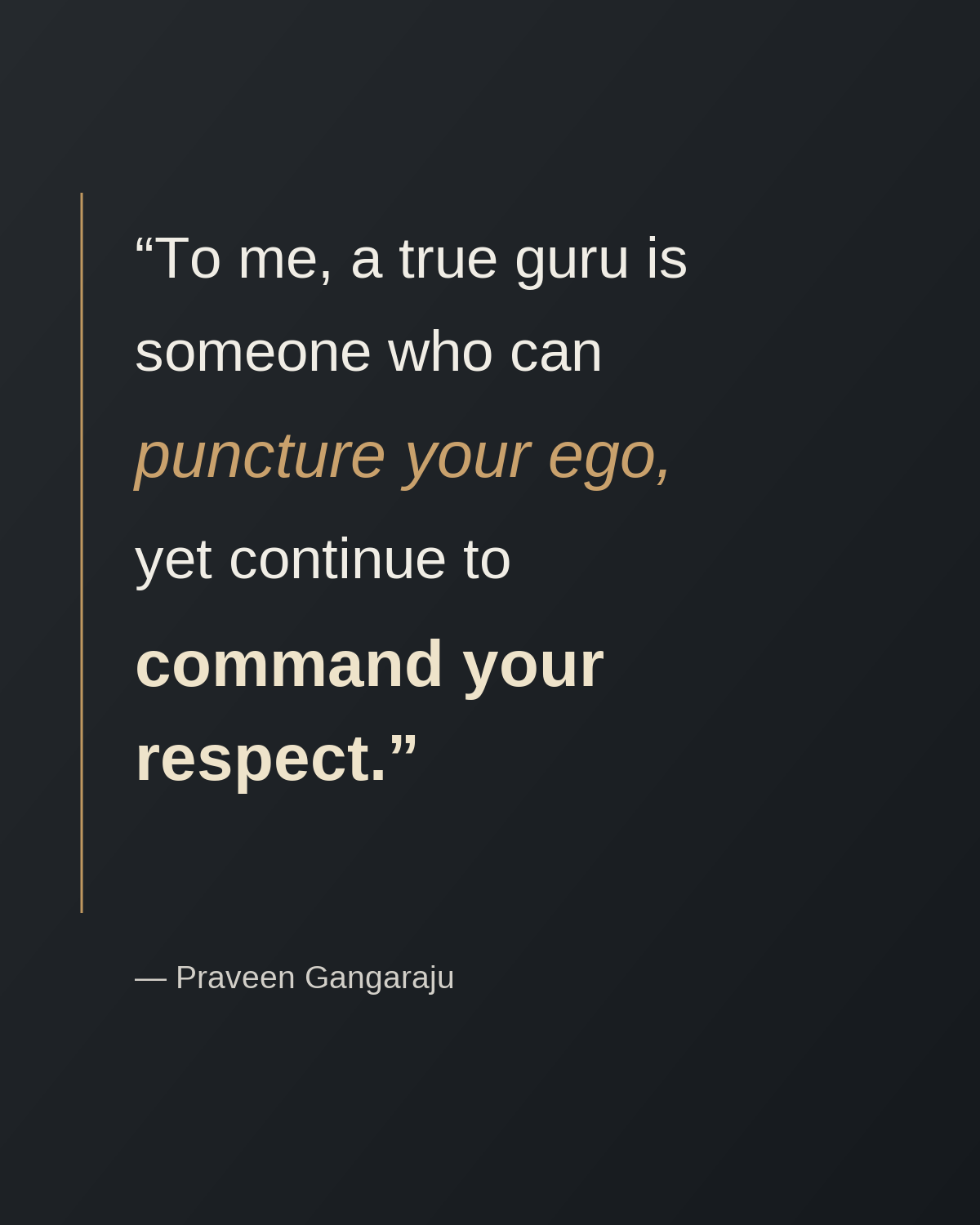
To me, a true guru is someone who can puncture your ego, yet continue to command your respect.
Shouldn't a good board be able to do the same?